

We need to talk about what we’re purchasing.
What $38 Billion Actually Bought
$38 billion. That’s what MilitarySpend Defense Economics Research tells us this latest conflict with Iran has cost so far—and that’s just the money part, just the line item we can trace through budgets and appropriations. Eighteen American families will never be whole again. Countless Iranian casualties—how many were holding a weapon, and how many were just trying to get bread? We’ve stopped counting carefully, which should tell you everything.
But here’s what I want you to sit with: Global violence costs us $14 trillion every year. That’s $5 per person, per day, extracted from every human on this planet. Your pocket. A child’s pocket in Mumbai. An elderly woman’s pocket in São Paulo. All of us, paying a daily fee for the privilege of living in a world that has chosen conflict as its operating system.
I’m not going to tell you war is simple to avoid. I won’t insult your intelligence by pretending geopolitics is easy, or that bad actors don’t exist, or that defense is never necessary. Those aren’t the lies that hope tells.
But hope does ask us to look at what we’re actually buying with our money and our grief.
What Peace Costs by Comparison
The United Nations runs its entire global peacekeeping operation—every mission, every peacekeeper, every conflict prevention program—on $3.2 billion annually. Read that again. The whole world’s organized effort to prevent and resolve conflicts costs less than one-tenth of what we’ve spent on this single war. It’s like spending $380 on a bandage while refusing to buy the $32 smoke detector.
Meanwhile, researchers estimate that $30 billion could rebuild entire regions if we chose peace. Not just rebuild infrastructure—rebuild hope, schools, hospitals, water systems, the daily mechanics of human dignity. We could give people futures instead of funerals.
Here’s a woman I want you to meet: Fatima, a Syrian engineer who spent three years in a refugee camp. When a peace-building NGO gave her community $50,000—not millions, just fifty thousand—she organized twenty other women. They started a mobile repair cooperative that now serves six villages. Last year, they taught 200 young people trades.
That’s what peace infrastructure looks like. That’s what we buy when we invest in solutions instead of explosions.
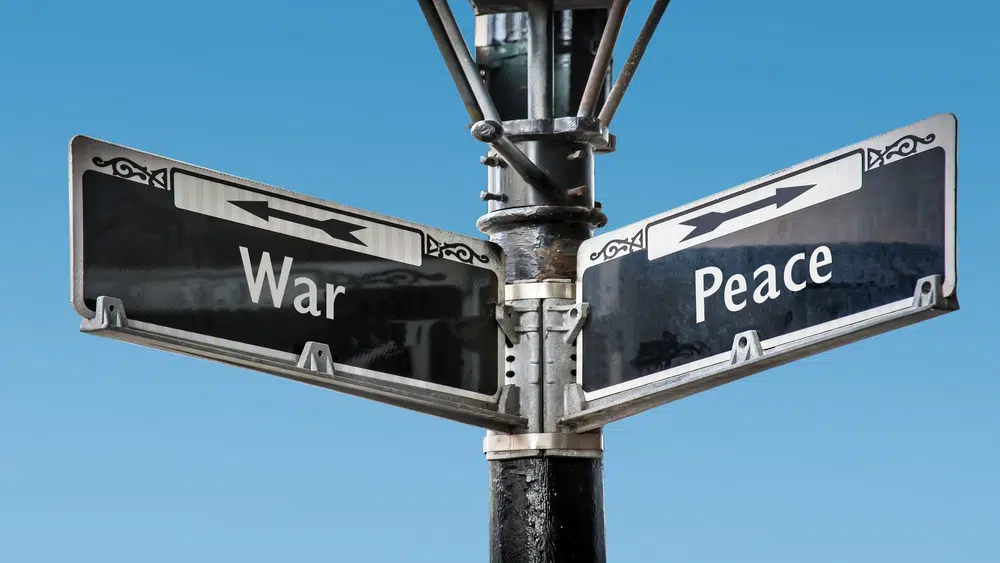
The cost of war vs. the cost of peace, the difference is huge – which do you chose.
And there’s Marc, a former U.S. Marine who came home from Iraq with PTSD and a head full of questions about what his service had built. He started a veteran-led organization that creates partnerships between former service members and communities in conflict zones—not as soldiers, but as builders, trauma counselors, agricultural advisors. “I learned how to break things really efficiently,” he told me. “Turns out I’m pretty good at putting things back together too.”
That’s twenty-three communities reached so far. Hundreds of people employed. Thousands of lives tangibly improved.
His program’s annual budget? $2.3 million. A rounding error in the cost of a single missile strike.
I know what you’re thinking: “But Hope, what about real threats? What about people who actually want to harm us?”
Yes. Those people exist. I’m not naive about that, and neither should you be. But consider this: the vast majority of conflicts that eventually explode into war show warning signs for years. Environmental stress. Economic inequality. Political marginalization. Ethnic tensions that could be addressed before they become ethnic cleansing.
We know how to read those signs. We have the tools to intervene early—mediation, development aid, education programs, economic partnerships, diplomacy. These things sound boring compared to military might. They don’t make exciting news footage.
But they work.
Every Dollar Spent on Prevention Saves $16
Every dollar spent on conflict prevention saves approximately $16 in future costs. Not $2. Not $5. Sixteen dollars. In pure economic terms—setting aside the incalculable value of human lives—peace is a spectacularly good investment.
So why don’t we make it?
Because war has momentum. Because defense contractors have lobbyists and peace advocates have bake sales. Because we’ve built entire economies around the machinery of violence, and changing course feels impossible. Because politicians get reelected for looking “tough,” not for preventing a war that never happens.
But also because we—you and me, regular humans—haven’t demanded better loudly enough.
Here’s the truth I want you to carry: Eighteen American families are shattered. Countless Iranian families will never recover. Every one of those lives was someone’s entire world. And we did not lack the resources or knowledge to choose differently. We lacked the will.
That can change. Not easily. Not quickly. But it can change.
There are people right now doing the unglamorous work of peace: negotiators sitting in uncomfortable rooms having the same difficult conversation for the fifteenth time. Researchers documenting human rights abuses so justice becomes possible. Teachers in conflict zones keeping schools open against impossible odds. Community leaders choosing reconciliation over revenge.
They need what we’ve been spending on warfare: resources, attention, political will, public support.
What We Can Do About It
You can start by learning one peace-building organization’s name and following their work. By writing one letter to your representative about conflict prevention funding. By refusing to let media outlets profit from war coverage without also covering peace efforts. By teaching one young person that strength includes knowing when not to fight.
$38 billion buys a lot of destruction. It also could have bought tens of thousands of rebuilt homes, hundreds of reconciliation programs, decades of sustainable development, a foundation for actual security.
We make these choices collectively. Which means we can make different ones.
The question isn’t whether peace is possible. The question is what we’re willing to invest in making it so. Because right now, we’re spending a fortune to stay trapped in cycles we know how to break.
Eighteen families deserved better. So do the rest of us.
The Cost of war vs the cost of peace – which do you chose?

Leave a Reply
You must be logged in to post a comment.