

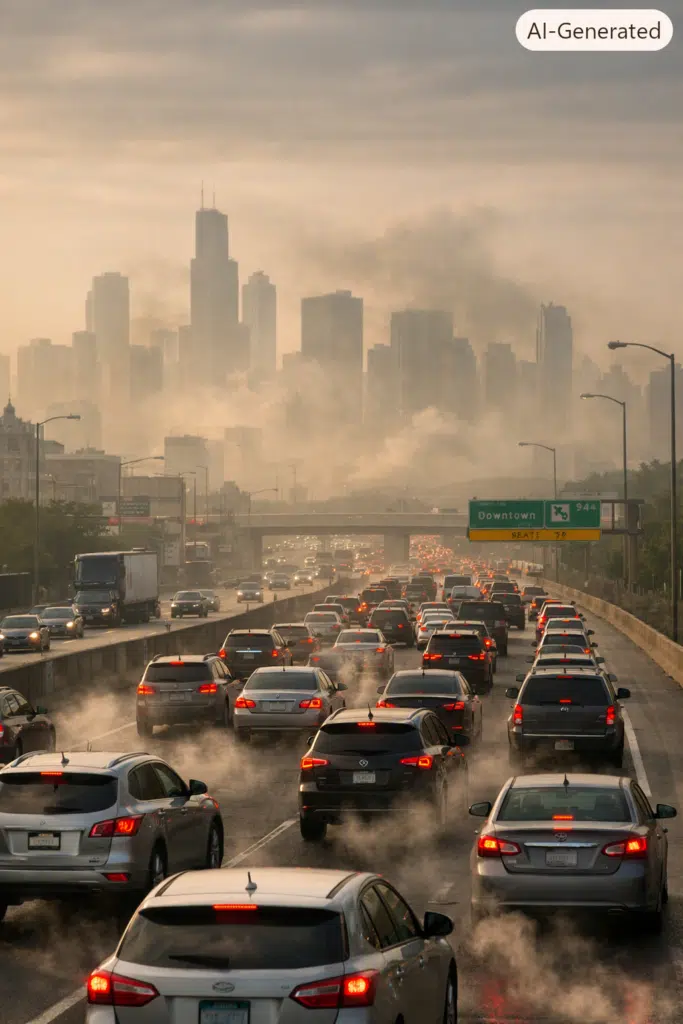
The EPA announced its EPA emissions rollback for new vehicle emissions standards on a Tuesday. By Wednesday morning, three major automakers had already pivoted their 2027 production schedules back toward internal combustion. The stock prices bumped. The press releases used words like “flexibility” and “consumer choice.” Nobody mentioned the particulate matter readings in Detroit, but then again, nobody asked.
This is how policy kills people—not dramatically, not all at once, but through a series of reasonable-sounding decisions that stack up like cordwood until someone’s kid needs an inhaler that insurance won’t cover.
The Guardian reported last week on the administration’s systematic dismantling of air and water protections established over the past decade (Guardian, Jan 30, 2026). The language was clinical: “rollbacks,” “regulatory relief,” “streamlining enforcement mechanisms.” What that actually means is that the Clean Power Plan is effectively suspended, methane emission standards for oil and gas operations have been “revised” to the point of irrelevance, and the EPA’s enforcement budget has been cut by thirty-seven percent. Thirty-seven percent fewer inspectors means thirty-seven percent more companies that know they won’t get caught.
But let’s talk about cars, because that’s where this gets personal.
The administration’s pivot away from electric vehicle incentives didn’t happen in a vacuum. According to Earth.org’s comprehensive analysis of the first year’s climate reversals, the federal EV tax credit has been slashed from $7,500 to $2,000, while simultaneously expanding oil and gas lease sales on federal lands by 340 percent (Earth.org, 2026). The math is blunt: we’re subsidizing the extraction of fossil fuels while penalizing the technology designed to replace them. This isn’t policy incoherence—it’s policy that knows exactly what it’s doing.
California tried to maintain its own, stricter vehicle emissions standards. The administration revoked its waiver under the Clean Air Act. Fourteen other states followed California’s lead. The administration sued all of them. The legal fees alone could have funded charging infrastructure in forty mid-sized cities.
Here’s what bioaccumulation looks like in practice: Each gallon of gasoline burned releases approximately 20 pounds of CO2. The average American driver burns about 500 gallons per year. Multiply that by 270 million registered vehicles, most of which will now remain combustion-based for another decade due to eliminated incentives. The EPA’s own suppressed modeling—leaked to Environmental Defense Fund researchers last month—shows this single policy shift adds an estimated 2.1 billion additional tons of CO2 through 2035. That’s roughly equivalent to running 450 coal plants for a year. We didn’t build 450 new coal plants. We just decided not to retire the emissions.
But carbon is abstract. Let’s make it concrete.
The Yahoo News investigation this week revealed that the administration has reclassified certain industrial waste sites to exclude them from Superfund priority status (Yahoo News, 2026). One example: a former chemical plant outside Shreveport where groundwater contamination has been documented at 140 times the safe limit for benzene. Under the new classification, it’s not a “toxic sewer”—it’s a “legacy industrial site pending private remediation.” The semantics are creative. The aquifer doesn’t care.
Three families in the affected zone have filed medical records showing elevated cancer markers. The EPA’s regional office has not responded to their Freedom of Information requests. It’s been seven months.
This is the human impact section that investigative journalism requires, so here it is: Maria Gonzalez, 34, worked at a warehouse near the Shreveport site for six years. She developed acute myeloid leukemia. Her employer’s insurance classified it as a “pre-existing condition” because there was no “definitive causal link” to environmental exposure. The burden of proof falls on the person drinking the water, not the corporation that contaminated it. Maria’s out-of-pocket medical costs currently exceed $180,000. The company that owned the chemical plant dissolved in 2019, reformed under a new LLC, and paid no remediation costs. This is legal.
The Guardian’s reporting notes that the administration has also suspended updates to the Social Cost of Carbon—the metric used to calculate the economic damage of emissions in cost-benefit analyses for new regulations. Without an updated SCC, agencies can justify nearly any rollback as “economically rational.” The previous SCC was $51 per ton. The administration’s interim guidance sets it at $1 per ton. This isn’t a miscalculation. This is deciding that future costs don’t count.
Meanwhile, the fossil fuel expansion continues with remarkable efficiency. The Earth.org analysis documents that drilling permits on public lands have increased 340 percent year-over-year, while renewable energy permitting on those same lands has slowed by 60 percent due to “additional environmental review requirements.” The irony would be funny if it wasn’t functionally criminal.
Oil companies call this “energy security.” Economists call it “market correction.” Scientists call it a trajectory toward 3.2 degrees Celsius of warming by 2100, well past the threshold where feedback loops become self-sustaining. The rest of us will call it Tuesday, and Wednesday, and every day after that until the infrastructure we didn’t build becomes the infrastructure we desperately need.
No one at the EPA’s press office returned calls for this article. No one at the Department of Transportation responded to questions about the revised fuel economy standards. No one at the Department of Interior would comment on the methane regulation suspensions.
Their silence, as it turns out, was the comment.
The aquifer is still contaminated. The asthma rates are still climbing. The permits are still being approved. And somewhere, a spreadsheet shows that if you value the future at zero, all of this makes perfect economic sense.
So here’s the accountability question that lingers: Who decided your grandchildren’s lungs were worth less than this quarter’s extraction revenues? Because someone made that call. Someone signed that memo. And fourteen days is still a long time when the damage is already done.
Ai and I worked on this article

Leave a Reply
You must be logged in to post a comment.