

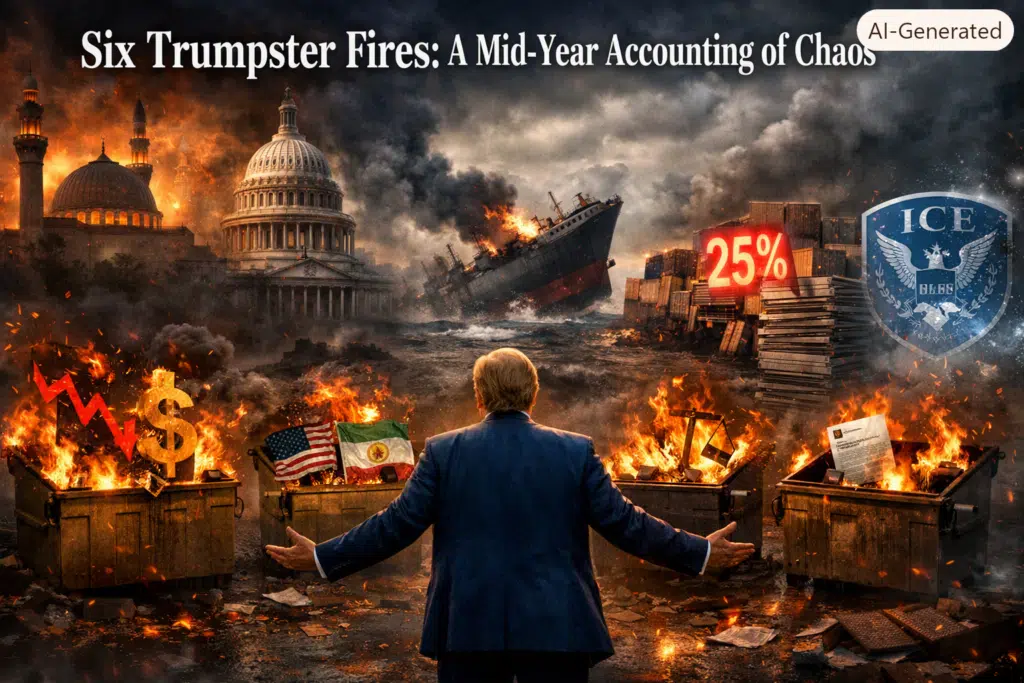
Seven months into President Trump’s second term, the United States is navigating a series of overlapping crises that span foreign policy, trade, immigration enforcement, federal leadership, and election administration. Each issue is unfolding simultaneously, creating a sense of national instability that has defined the summer of 2026. This mid-year overview summarizes the six most significant flashpoints shaping the country’s political and policy landscape as of late July.
A Breakdown of the six Trumpster fires
Fire One: The Expanding Conflict With Iran
The U.S.–Iran confrontation has intensified into a multi-front conflict affecting two of the world’s most critical maritime chokepoints: the Strait of Hormuz and the Bab el‑Mandeb.
According to recent Department of Defense briefings (DoD, July 2026), U.S. forces have conducted multiple consecutive nights of airstrikes targeting Iranian missile sites, naval assets, and command infrastructure. Iran has responded with drone and missile attacks on U.S. positions in Jordan and strikes on civilian infrastructure across the Gulf.
The conflict has disrupted global shipping:
- Oil tanker traffic through the Strait of Hormuz has significantly slowed, contributing to oil prices rising above $88 per barrel (Energy Market Reports, July 2026).
- Iran‑aligned Houthi forces have escalated attacks in the Red Sea, threatening the Bab el‑Mandeb, a passageway that carries 10–12% of global trade (International Maritime Bureau, July 2026).
Diplomatic channels remain limited. Analysts note that no formal negotiations are underway, and regional partners are bracing for prolonged instability.
Fire Two: Tariff Expansion After Supreme Court Limits
The Supreme Court’s February 2026 ruling in Learning Resources v. Trump restricted the administration’s use of emergency powers to impose tariffs without congressional approval. The decision was widely interpreted as a significant check on executive authority.
However, the administration has since shifted strategy. Rather than scaling back tariffs, President Trump has expanded them under Section 301 trade authority, which allows tariffs in response to unfair trade practices.
As of July 2026:
- The administration has imposed 10–12.5% tariffs on goods from approximately 60 economies (Office of the U.S. Trade Representative, July 2026).
- The stated justification is combating forced labor, though economists warn the broad application risks retaliatory measures and higher consumer prices (Peterson Institute for International Economics, July 2026).
Canada and China recently resolved their bilateral disputes over electric vehicles and agricultural exports, but U.S.–Canada tensions remain elevated due to the expanded tariff list.
The Supreme Court’s ruling continues to shape the legal environment, but the administration’s pivot to Section 301 has kept tariff policy at the center of economic debate.
Fire Three: Epstein Files and DOJ Turbulence
The long-running legal battle over the release of sealed Jeffrey Epstein documents remains unresolved. While the issue has been overshadowed by foreign policy and economic developments, federal courts continue pressing the Department of Justice for compliance with earlier orders requiring the release of investigative materials.
The broader context is significant: the DOJ has experienced record turnover in 2026, with 27 Senate-confirmed officials departing since January (Congressional Research Service, July 2026). This includes senior leaders responsible for overseeing document compliance and transparency.
Victims’ advocacy groups continue to call for full disclosure, arguing that delays undermine public trust. The courts have not issued new contempt rulings in 2026, but judges have reiterated that compliance remains mandatory.
Fire Four: ICE Enforcement and Rising Fatalities
Immigration enforcement has intensified sharply in 2026, with ICE reporting some of its highest arrest and detention numbers in years.
Record Enforcement Levels
- ICE booked 43,138 individuals into detention in June 2026 — the highest monthly total since President Trump returned to office (ICE Enforcement and Removal Operations Report, June 2026).
- Daily arrests in July have ranged from 1,400 to over 1,500, with peak days exceeding 2,000 (DHS Operational Briefing, July 2026).
- The national detention population has surpassed 63,000.
Fatal Incidents
Several fatal encounters in July have drawn national attention:
- Houston (July 7): ICE agents fatally shot Lorenzo Salgado Araujo, a longtime resident with no criminal record. DHS later confirmed he was not the intended target (DHS Statement, July 2026).
- Biddeford, Maine (July 13): Agents shot and killed Johan Sebastián Durán Guerrero, a legally authorized worker. He was also not the intended target (Maine Attorney General’s Office, July 2026).
- Florida (July 16): A man was killed when a tractor-trailer fleeing ICE collided with his vehicle (Florida Highway Patrol Report, July 2026).
Civil rights organizations have criticized ICE’s tactics, while DHS maintains that vehicle stops and rapid-response operations are essential. The administration briefly paused certain enforcement methods, but President Trump publicly directed DHS to resume them.
Fire Five: Leadership Turnover and Confirmation Battles
Federal leadership instability has become a defining feature of 2026. The administration has seen unprecedented turnover in Senate-confirmed positions, affecting continuity across multiple agencies.
Key Developments
- 27 Senate-confirmed officials have left their posts since January (Congressional Research Service, July 2026).
- Many agencies — including DHS, ICE, FDA, and CDC — are now led by acting officials, limiting oversight and complicating policy implementation.
Major Nominations
- Jay Clayton, nominated for Director of National Intelligence, faces bipartisan scrutiny over past statements and actions, including his refusal to acknowledge the certified results of the 2020 election and his role in subpoenaing journalists (Senate Intelligence Committee Hearings, July 2026).
- Other leadership vacancies remain unfilled, contributing to operational uncertainty across federal departments.
The turnover has raised concerns among governance experts about institutional resilience and long-term policy stability.
Fire Six: Mail-In Voting Restrictions Blocked by Courts
President Trump’s March 2026 executive order seeking to restrict mail-in voting for federal elections has faced multiple legal setbacks.
Key Court Actions
- June 25: A federal judge ruled the order unconstitutional, stating it exceeded executive authority (U.S. District Court, June 2026).
- July 1: A second ruling blocked USPS from implementing ballot-handling changes tied to the order (U.S. District Court, July 2026).
- July 21: The D.C. Circuit issued a temporary stay allowing limited enforcement, prompting immediate challenges from voting rights groups.
- July 25: The First Circuit declined to lift the injunction, preventing implementation in 23 states (First Circuit Court of Appeals, July 2026).
This marks the administration’s fourth major defeat on mail-in voting restrictions in 2026. Legal experts note that states retain primary authority over election administration, and courts have consistently reinforced that principle.
The Bigger Picture
Taken together, these six Trumpster fires, these areas illustrate a period of significant national strain. Foreign conflict, trade volatility, immigration enforcement, leadership turnover, and election administration disputes are unfolding simultaneously, creating a complex and often unpredictable policy environment.
As the country moves into the second half of 2026, the central question is how these pressures will shape governance, public trust, and institutional stability in the months ahead. The fires are ongoing, and the nation’s capacity to manage them remains a subject of close scrutiny.

Leave a Reply
You must be logged in to post a comment.