
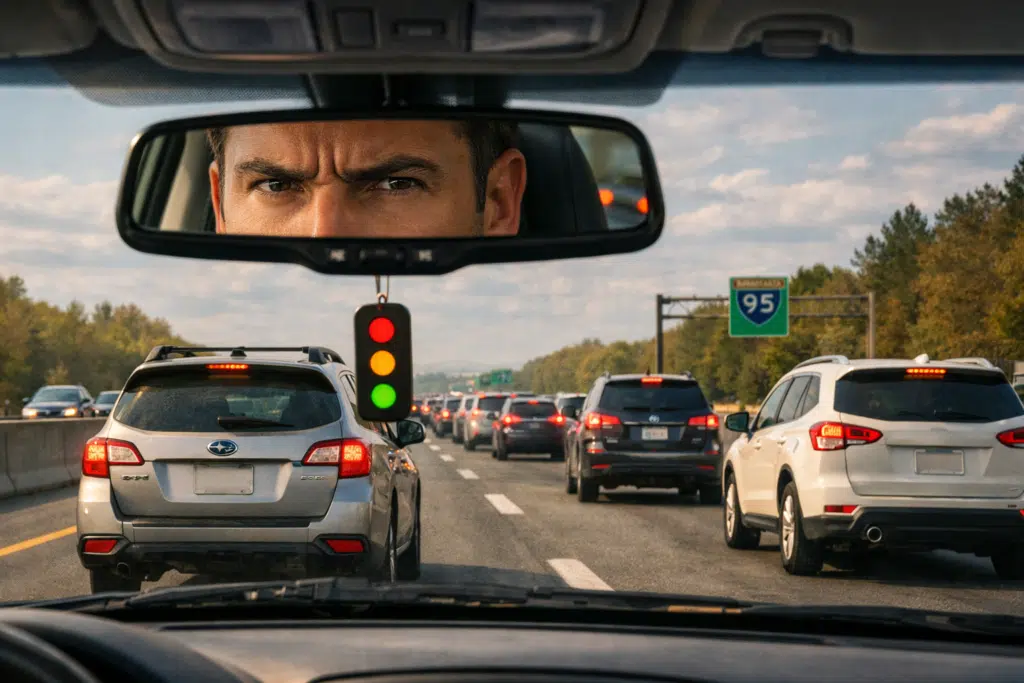
Road awareness driving is a lost art in America. There I am, Thursday morning, Interstate 95, trying to pass a Subaru Outback doing exactly 63 miles per hour in the left lane. I signal. I accelerate. And like clockwork—like some bizarre automotive mating dance—the Subaru speeds up to 68. Then 71. Then, mon Dieu, 74.
I glance over. The driver looks back. The eyes say it all: “You shall not pass.”
What is this madness?
Road Awareness Driving: Left Lane Camping Problem
In France, we have problems, bien sûr. But this peculiar American highway ballet—this passive-aggressive waltz of acceleration and obstruction—it baffles me completely. The left lane is for passing. This is not philosophy. This is not open for interpretation. It is printed in your driver’s manual, which apparently doubles as decorative literature for most glove compartments.
Here is what I see every single day: drivers camping in the passing lane like they’ve pitched a tent and started a fire. When you attempt to pass—performing the lane’s actual function—they suddenly remember their accelerator exists. Some do this consciously. You can see it in their faces when you pull alongside. That little smirk. That territorial glance. As if you’ve personally insulted their grandmother by wanting to drive faster than 63 in a 65.
Others? They’re in another dimension entirely. You pull up, and they don’t even notice you exist. They’re conducting a symphony only they can hear, lost in thought, blissfully unaware that twelve cars are stacked behind them like dominoes waiting to fall.
The Two-Lane Country Road Roadblock
And then—oh, and then—there’s the two-lane country road phenomenon. Two cars, driving side-by-side at identical speeds, creating a rolling roadblock of extraordinary effectiveness. Behind them: a funeral procession of fifteen vehicles. The drivers? Completely oblivious. Check your rearview mirror, people! It came with the car! It serves a purpose!
The rearview mirror is not a decoration. It is not there to admire your lipstick or practice your serious face. It is there to remind you that you are not alone on this planet, that other humans exist, that perhaps—just perhaps—you should be aware of your surroundings.
The Stoplight Phone Zombie
But my absolute favorite—and by favorite, I mean the thing that makes me want to lie down in the road—is the stoplight phone zombie. The light turns green. Nothing happens. Five seconds. Ten seconds. Finally, someone honks. The driver looks up, startled, as if awakened from cryogenic sleep, and lurches forward. Congratulations: you’ve made three cars miss the light because your text message about dinner plans could not wait forty-five seconds.
Where is this in driver’s education? Where is the chapter on awareness? On consideration? On the radical concept that driving is not a solitary activity but a collective endeavor requiring mutual respect?
We need Driver Etiquette 101. Required course. No exceptions. Topics include: The Left Lane Is Not Your Personal Cruise Control Zone. How to Use a Rearview Mirror Without Turning Into a Pillar of Salt. And the Advanced Seminar: Other People Exist and Have Places to Be.
I’m not asking for perfection. I’m asking for attention. For awareness. For the simple courtesy of knowing where you are and what you’re doing.
Is that really too much to ask?
Apparently yes. But I’ll keep hoping anyway.
Because the alternative—accepting this automotive chaos as permanent—is too depressing to contemplate.

Leave a Reply
You must be logged in to post a comment.