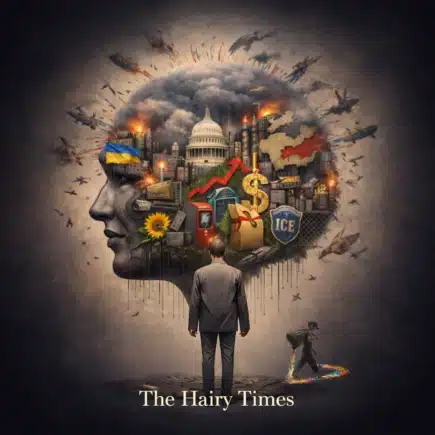

This is a story about greatness — or what’s left of it.
There’s a line in Hemingway where a character is asked how he went bankrupt. “Two ways,” he answers. “Gradually, then suddenly.”
That’s how democracies fail. Not with a dramatic collapse, but through a thousand small cuts—each one justified, each one rationalized, until one morning you wake up and don’t recognize the country staring back at you.
So let’s ask the uncomfortable question out loud: Are we better off than we were a year ago? Two years ago? And more importantly, is this version of America—the one we’re living in right now—what “great” is supposed to look like?
The answer depends on who you are and what you value. But the facts, as they say, don’t care about our feelings.
The Body Count
Start with Immigration and Customs Enforcement operations. According to reports compiled from multiple news sources and advocacy organizations, ICE raids have intensified dramatically over the past year. Three new deaths have been attributed to ICE custody in recent months—adding to a tally that should trouble anyone who believes in basic human dignity, regardless of immigration status.
These aren’t abstractions. These are people—detained under conditions that multiple inspectors general have flagged as inadequate—who died on American soil, under American authority. One was a diabetic man whose medical needs were ignored. Another, a woman who suffered a seizure that went untreated for hours.
Is that greatness? Or is that a moral stain we’ll spend generations trying to scrub out?
The Strait of Hormuz and a War Nobody Voted For
Then there’s Iran. The Strait of Hormuz—through which roughly 21% of global petroleum passes—has become a flashpoint for a conflict that escalated not through congressional debate, not through national consensus, but through unilateral executive action.
An airstrike. A tweet. A declaration. And suddenly, we’re teetering on the edge of a war that no one voted for, that serves no clear American interest, and that threatens to destabilize global markets just as ordinary people are struggling with inflation and economic uncertainty.
The Constitution is clear: Congress declares war. One person—no matter the office—doesn’t get to drag 330 million people into armed conflict because of a personal grievance or a desire to look tough. That’s not leadership. That’s recklessness dressed up in flag pins.
Trade Wars and the Poorest Pay
Speaking of economic policy: the trade war. Tariffs sold as protecting American workers have instead raised prices on everyday goods—washing machines, steel, electronics—which disproportionately hurt working-class and middle-class families. Meanwhile, the wealthiest—those positioned to weather any storm—continue to consolidate power.
Case in point: the richest man in the world now apparently has a seat at the policy table, while USAID—the United States Agency for International Development—faces elimination. USAID, for context, provides emergency food assistance, combats disease outbreaks, and supports economic development in the world’s most vulnerable regions. Cutting it doesn’t save meaningful money in a $6 trillion federal budget. But it does send a message: America no longer cares about being a moral leader on the global stage.
It’s a policy that screams “I got mine” while the world burns.
The Rot at the Top
But here’s what may be worse than any individual policy failure: the erosion of leadership itself.
What we’ve gotten instead is governance by tantrum. Name-calling. “Sleepy Joe.” “Crooked Hillary.” “Ron DeSanctimonious.” The kind of schoolyard taunting that would get a seventh-grader sent to the principal’s office. Except this is coming from the Oval Office.
We’ve watched as a sitting president has sought to control not just policy, but culture—intervening in sports, pressuring media companies, attempting to dictate how private businesses operate, even weighing in on what should happen to national parks. This isn’t governance. It’s micromanaged authoritarianism with a side of petty grievance.
A true leader doesn’t need to tear others down to build themselves up. A true leader doesn’t treat disagreement as treason. A true leader doesn’t govern through fear, anger, and performative cruelty.
The Question We’re Avoiding
So here it is, plain and uncomfortable: Is this who we are as Americans?
Is this the vision we want for our children—that success means crushing the opposition, that strength means never admitting error, that patriotism means blind loyalty rather than honest critique?
Because if that’s the case, then the words chiseled into our monuments and stitched into our founding documents don’t mean a damn thing.
“We the People.” “E Pluribus Unum”—out of many, one. “Give me your tired, your poor.” These weren’t just slogans. They were aspirations. Imperfectly pursued, sure. But pursued nonetheless.
What we have now feels less like aspiration and more like degradation. The anger is louder. The hate more visible. The corruption more brazen. The greed more unabashed.
One Person Can Make a Difference
John F. Kennedy once said, “One person can make a difference, and everyone should try.”
He was right. But here’s the corollary: one person can also make things worse. And when that person holds the highest office in the land, the damage compounds quickly.
The good news? We’re not powerless. The machinery of democracy—battered as it is—still functions. Elections still happen. Voices still matter. The question is whether we’ll use them.
Because the path we’re on doesn’t lead to greatness. It leads to a country where cruelty is policy, where might makes right, where the loudest voice wins and the vulnerable lose.
That’s not the America that stormed Normandy or put a man on the moon or built the interstate highway system. That’s not the America that led the world through vision and principle, however imperfectly.
That’s something smaller. Meaner. More fragile.
Is that what we want?
If not, then it’s time to say so. Loudly. Join the conversation. Share your thoughts. Your opinion counts—but only if you use it.
Because if we don’t make a difference now, we’ll be left asking a much harder question: How did we let this happen?
Harry Tukis – The Hairy Times

Leave a Reply
You must be logged in to post a comment.