

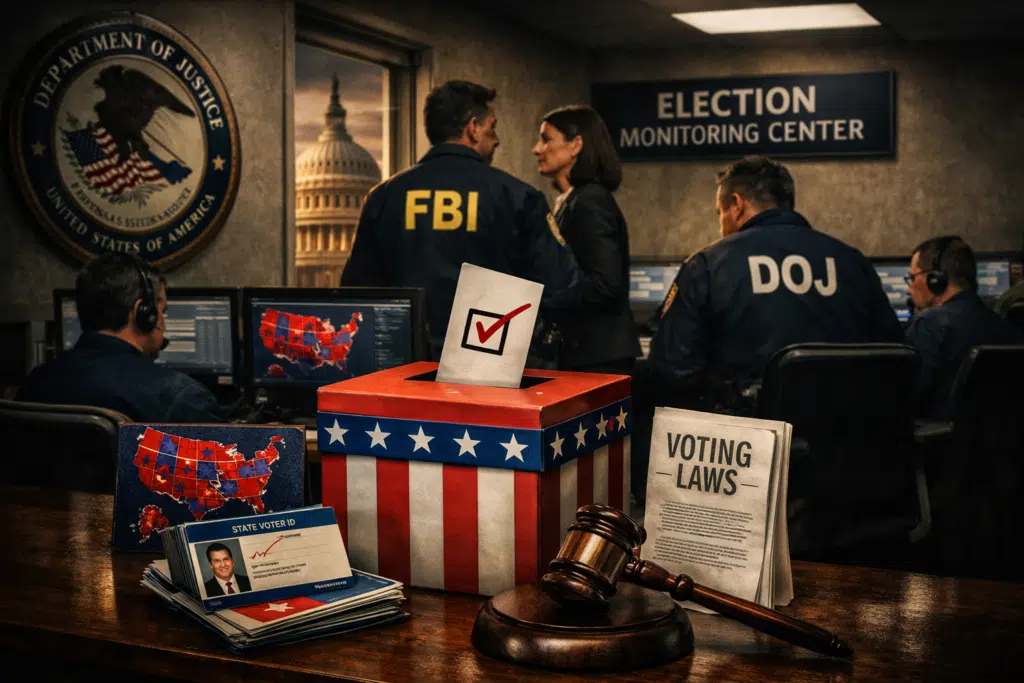
Look, I’m going to level with you: I’ve watched a lot of countries argue about who controls their elections. I’ve seen what happens when trust evaporates. And what’s happening in America right now — this quiet, procedural war over voting rules — is one of those moments that looks boring until suddenly it isn’t. Ask yourself do you trust this administration to guard the gate with the Federal Power to control our elections? This brings us to the broader topic of Federal Power and the Fight Over Elections.
The federal government is making moves. Big ones. The kind that could fundamentally reshape who has authority over elections, how they’re run, and who decides what “fair” means. Supporters frame it as protecting democracy from chaos and fraud. Critics see a power grab dressed up in security language.
Both sides have a point. That’s what makes this so damn complicated.
Let me walk you through what’s actually on the table — and why you should care, even if congressional bills make your eyes glaze over.
**The SAFE Act: Standardization or Overreach?**
The Secure and Fair Elections Act sounds reasonable enough. Paper ballots. Standardized machines. Federal funding for election infrastructure. More oversight from the Department of Homeland Security and the Election Assistance Commission. DHS already handles cybersecurity for elections; the SAFE Act expands that role into operational oversight. Again sounds like overreach to me, what are your thoughts?
The pitch is simple: make elections consistent, secure, and harder to manipulate.
The problem? “Consistent” and “controlled” are cousins. And not the fun kind.
Requiring paper ballots nationwide — sure, that’s a safeguard most experts support. But giving DHS and federal commissions expanded authority to oversee state election systems? That’s where state officials start pulling out their pocket Constitutions and muttering about the Tenth Amendment.
Here’s the thing: America’s elections have always been decentralized. That’s by design. It makes them harder to hack, harder to corrupt wholesale, and it reflects the federal structure of the country. Fifty states, fifty systems, fifty points of failure — or fifty layers of protection, depending on your perspective.
The SAFE Act would tilt that balance toward Washington. And once you centralize authority, you also centralize risk. If federal agencies become the arbiters of election security, what happens when those agencies are led by someone you don’t trust? Because in case you haven’t noticed, administrations change. Power doesn’t stay in friendly hands forever.
I’m not saying the bill is inherently dangerous. I’m saying it’s a trade-off. More uniformity, less local control. More federal oversight, more vulnerability to federal politicization.
You decide if that’s a deal worth making.
**Redistricting: Fighting Gerrymandering or Creating New Weapons?**
Then there’s redistricting reform — another idea that sounds great until you look at the fine print.
The administration supports replacing partisan state legislatures with “independent commissions” when it comes to drawing congressional districts. The goal is to reduce gerrymandering, where politicians draw maps that guarantee their party stays in power.
Noble aim. Gerrymandering is a cancer on representative democracy. It lets politicians choose their voters instead of the other way around.
But here’s where it gets messy: who decides what “independent” means?
If the federal government sets standards for these commissions — who qualifies, how they’re selected, what criteria they use — you haven’t eliminated politics. You’ve just moved it up a level. The party in power in Washington could effectively control redistricting nationwide by shaping the rules that supposedly take politics out of the process.
It’s a shell game. And the stakes are enormous. Redistricting happens once a decade and determines which party controls the House of Representatives for the next ten years. Shift a few districts in a few swing states, and you shift the entire balance of power in Congress.
So yes, we need to fix gerrymandering. But federalizing the solution could just replace fifty state-level messes with one national mess — and concentrate that mess in the hands of whoever currently runs the federal government.
That should make everyone nervous.
**The “Election Integrity Army”: Oversight or Intimidation?**
Now for the truly eyebrow-raising proposal: an “election integrity army.”
The president has floated the idea of creating a network — federal employees and trained volunteers — to monitor elections for fraud and irregularities. On paper, it’s about ensuring fair counting and preventing interference.
In practice? It could be a disaster.
Election monitoring in the U.S. has always been handled by bipartisan local officials. Poll watchers from both parties, observers from nonpartisan groups, transparent processes with checks and baked-in accountability. It’s not perfect, but it’s designed to prevent any one faction from controlling the process.
A federally organized “army” changes that dynamic entirely. Suddenly you have a top-down structure answering to Washington, deployed to monitor local officials who may or may not trust the people watching them. The potential for intimidation — intentional or not — is enormous.
And let’s be honest about the language here: “army.” That’s not an accident. It’s meant to sound strong, protective, ready for battle. But elections aren’t supposed to be battlefields. They’re civic processes that require trust, transparency, and buy-in from all sides.
Militarizing the rhetoric around election oversight — even metaphorically — poisons the well. It turns election workers into enemies or allies instead of neutral administrators. It makes every challenge sound like an act of war.
I’ve seen this movie before, in other countries. It doesn’t end well.
**Why This Matters More Than You Think**
Here’s the bigger picture: these three efforts — the SAFE Act, redistricting reform, and federal election monitoring — represent a fundamental shift in who holds power over American elections.
They could make voting more secure. They could standardize access and reduce chaos. Those are real benefits.
But they also concentrate authority in Washington, reduce state and local control, and create new vulnerabilities if that federal authority is abused or corrupted.
The debate isn’t really about voter access or election security. Those are the surface arguments. Underneath, this is about trust — who you trust more, your state government or the federal government, and what happens when the people you trust lose power.
Because they will. Eventually, they always do.
So the question you should be asking isn’t whether these proposals sound good in theory. It’s whether you’re comfortable with the other side — whichever side that is for you — having these same powers in a few years.
If the answer is no, then maybe we need to think harder about how much authority we’re willing to hand over in the name of security.
Democracy is messy. Decentralization is frustrating. But concentration of power is almost always more dangerous than the chaos it’s meant to solve.
Just something to chew on while Washington decides who gets to guard the gate.
— Andrew Hahn
This is an article AI and I have worked on together

Leave a Reply
You must be logged in to post a comment.